
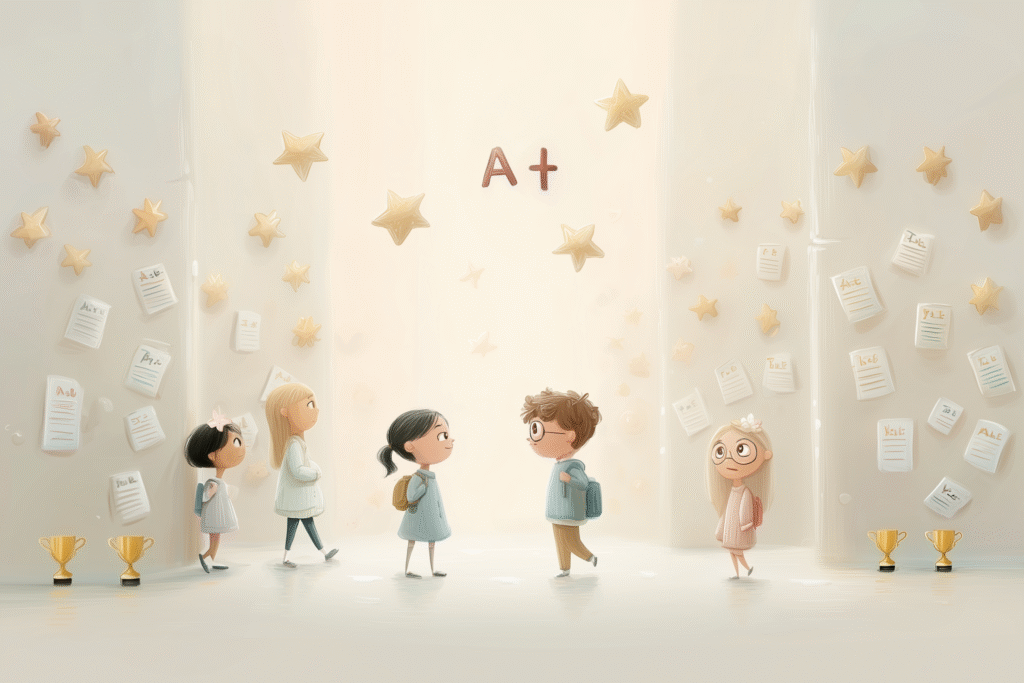
Mistakes can feel scary to children, especially in a world of constant comparison. But their brains see errors very differently. Beneath every wrong answer, the brain is sending powerful learning signals, updating its predictions, and building new connections. This article explains the science of mistakes and offers concrete, research-based ways to help kids see errors not as proof they “can’t,” but as evidence that their brain is growing.
The Importance of Celebrating Mistakes from a Young Age
A five-year-old finishes a writing exercise on a new learning app.
The screen flashes: 2 out of 3 stars.
From an adult’s point of view, that might mean, “Great challenge level to practice. Not too easy, not too difficult!”
For the child, the message can look very different:
“Nope, you didn’t get it. You’re not really good at this!”
The child feels disappointed and frustrated, and may not have much motivation to use the app again.
Wanting to succeed can be a very healthy part of growing up. It helps children practice discipline, persistence, and goal-setting. But when the messages they receive suggest that stars, A+ grades, and winning matter more than learning, curiosity, or effort, their self-worth can become tightly tied to performance. In that atmosphere, a mistake becomes a threat to how they see themselves.
Children and teens today are not only setting high standards for themselves; many also feel watched, compared, and judged by others more than ever before. They may worry that everyone will be disappointed if they don’t get top marks, or that one slip-up will change how people see them. Often, adults are not intentionally sending these messages, but children still experience a constant pressure to please and perform.
Research shows that perfectionism has increased by about one-third over the last three decades. This doesn’t appear out of nowhere. Perfectionism has grown in a context shaped by culture, family, school, and the messages children absorb every day.
From early childhood, kids move through a world filled with stars, scores, and rankings. Competitiveness in extracurricular activities is almost omnipresent. As they grow older, social media amplifies these comparisons. They may scroll through carefully curated snapshots of other people’s achievements, talents, and “perfect” moments and quietly measure themselves against what they see.
Parenting practices also play a role. Many parents, out of love and a desire to prepare their children for a competitive world, may lean toward overprotection from mistakes. They rush in to prevent errors or fix problems quickly. Over time, children can learn that mistakes are dangerous, something to be avoided rather than explored.
Another common pattern is a strong focus on outcomes. When most conversations revolve around grades, scores, and rankings (“What did you get?”) and much less on effort, strategies, or curiosity (“What did you discover?”), children may feel that they are valued mainly for their performance. When they sense that their value, and their parents’ pride, depends on results, they become highly sensitive to any imperfection.
So, how can we change this narrative and help children see mistakes as an integral part of learning rather than something to fear or avoid?
The Science of Mistakes: Why Errors Help the Brain Grow
The brain actually needs mistakes to learn. But what exactly happens in the brain when we make a mistake?
The brain has a fast “mistake alarm.”
When we make an error, the brain produces a very rapid signal called the error-related negativity (ERN) in a region that monitors performance (the anterior cingulate cortex). This happens within about 50–100 milliseconds after a mistake, often before we are consciously aware of it. It’s the brain’s way of flagging, “Something did not go as expected,” so that ongoing processing can be adjusted. This early signal is the first step in turning a mistake into useful information.
Mistakes recalibrate the brain’s prediction system.
The brain is constantly generating predictions about what will happen and comparing them to reality. When the outcome is different from what was expected, such as getting an answer wrong, dopamine neurons send a prediction error signal to learning circuits in the striatum and cortex. This signal tells the brain that its internal model needs updating: connections that led to poor predictions are weakened, and better strategies are strengthened.
Errors trigger increased control and carefulness.
Once an error has been detected, control networks in the prefrontal cortex are recruited. This often leads to “post-error slowing,” where the person automatically becomes more cautious and deliberate on the next trial. Neural activity shows a shift toward increased attention, conflict monitoring, and strategy adjustment. What looks like simple hesitation from the outside is actually the brain reallocating resources to prevent repeating the same mistake.
Mistakes build “negative knowledge,” a library of what doesn’t work.
When we make a mistake and get feedback, the brain encodes not only the correct response but also information about what was wrong and why. This is sometimes called negative knowledge: knowing which options or strategies to avoid. Such knowledge helps the brain distinguish between very similar choices and reduces the chance of repeating the same error. Mistakes we make when we feel very confident can be remembered particularly well, making them powerful learning moments.
When Ego Threats Shut Down Learning
Underneath all this, there’s a key tension: the brain loves mistakes, but the ego does not. When children experience failure as a threat to their identity (“I’m not good at this” rather than “this strategy didn’t work”) they tend to shut down. Studies show that ego-threatening failure feedback makes people tune out and stop processing the very information that could help them improve. In those moments, attention shifts from the task to self-protection, and the brain’s learning systems are put on pause. Over time, this kind of tuning out can weaken motivation and commitment to a goal. Helping children see mistakes as information about what to try next, rather than a verdict on who they are, helps keep children’s minds open and engaged.
Below are practical, research-informed ways parents and educators can support a healthier relationship with mistakes.
From Science to Practice
Teach Kids That Mistakes Are Part of Learning
Children are more willing to take risks and stay motivated when they understand why something matters. When errors are framed as information, signals that the brain is practicing, stretching, and forming new connections, children are less afraid of trying, exploring, and taking academic risks.
Helpful practices:
Explain simply what happens in the brain during learning.
For example: “Every time you make a mistake and try again, your brain is growing and making new connections.”
Normalize struggle as a sign of growth.
Help children see difficulty as part of the process, not a problem to avoid:
“If it feels hard, that’s proof that your brain is working hard and learning.”
Highlight the value of ‘what doesn’t work.’
Point out that wrong turns also carry useful information:
“Knowing what doesn’t work is just as important for your brain as knowing the right answer, because it helps you avoid old traps next time.”
Support a Growth Mindset
Adults can help children develop a growth mindset by the way they talk about ability, effort, and mistakes.
A fixed mindset suggests that intelligence and talent are mostly inherited and unchangeable: some kids are “smart” and some are not. A growth mindset, on the other hand, emphasizes that abilities can develop over time through effort, strategies, feedback, and practice.
When children repeatedly hear messages like “You’re so smart,” “You’re a natural,” or, on the other side, “You’re just not a math person,” they begin to see their abilities as fixed. In a fixed mindset, errors become evidence that something is wrong with them. A wrong answer feels like a label.
In a growth mindset, mistakes look very different. They are signals that the brain is stretching, learning, and building new connections. Struggle is proof that learning is happening. The same event, a failed attempt, can either shut a child down or help them grow, depending on the mindset they’ve learned to adopt.
Research has shown that when students are encouraged to see abilities as changeable and are praised for effort and strategies rather than performance alone, they tend to stay engaged longer and bounce back more easily from setbacks.
Helpful practices:
Praise effort and persistence.
Instead of “You’re so smart,” try:
“You kept going, even when it was tough.”
“I noticed how you tried a new strategy.”
Highlight process, not just results.
“You planned your steps and adjusted when something didn’t work. That’s what helped you improve.”
Encourage Reflection Instead of Jumping In
When adults step in too quickly to fix a problem, children may get the right answer, but they miss an essential part of learning: thinking through the error themselves. Reflection helps children notice what they tried, what went wrong, and what they might change. Over time, this builds metacognition, “thinking about their own thinking”, which is strongly linked to deeper, more flexible learning.
Helpful practices:
Pause before helping.
Allow a moment of silence after a child gets stuck or makes a mistake. That pause gives their brain a chance to search for another strategy.
Use open questions to focus on their process.
Instead of telling them what to do next, invite them to analyze their own work:
“What do you notice if you look at that step again?”
“Where do you think it started to go off track?”
Let them explain their thinking out loud.
Encourage children to walk you through what they were trying to do. Even if their explanation is incomplete, the act of organizing and verbalizing their thoughts strengthens understanding and helps them learn from the mistake.
Model the Attitude You Want Them to Learn
Children watch carefully how adults handle their own mistakes. When they see adults treating errors as part of life rather than disasters, they learn to do the same.
Helpful practices:
Use kind self-talk aloud.
“That didn’t work, but I’ll figure it out. What could I try differently?”
Stay calm when things go wrong.
Try not to get overly frustrated when you make a mistake. Children need to see that it’s possible to get something wrong and still stay calm and positive.
Share your own learning stories.
Occasionally let children know about times you tried, struggled, and overcame your challenges. This makes “trial and error” feel normal and human.
Turning Mistakes into Allies
The goal is not to remove frustration from children’s lives or make everything easy. The goal is to help them understand that:
- Mistakes are a normal, necessary part of learning. Every attempt, especially the imperfect ones, helps their brain grow.
- Their worth is not defined by grades, scores, or perfect outcomes.
When adults create safe spaces for errors, support a growth mindset, and respond to mistakes with empathy and curiosity, children become more confident, resilient learners. They don’t just learn to “cope” with getting things wrong.
They discover that mistakes are not the enemy, they are one of their best teachers.
References
Curran, T., & Hill, A. P. (2019). Perfectionism is increasing over time: A meta-analysis of birth cohort differences from 1989 to 2016. Psychological bulletin, 145(4), 410.
Eskreis-Winkler, L., & Fishbach, A. (2019). Not learning from failure—The greatest failure of all. Psychological science, 30(12), 1733-1744.
Fernández-García, O., Gil-Llario, M. D., Castro-Calvo, J., Morell-Mengual, V., Ballester-Arnal, R., & Estruch-García, V. (2022). Academic perfectionism, psychological well-being, and suicidal ideation in college students. International journal of environmental research and public health, 20(1), 85.
Flett, G. L., Hewitt, P. L., Nepon, T., Sherry, S. B., & Smith, M. (2022). The destructiveness and public health significance of socially prescribed perfectionism: A review, analysis, and conceptual extension. Clinical psychology review, 93, 102130.
Hajcak, G. (2012). What we’ve learned from mistakes: Insights from error-related brain activity. Current Directions in Psychological Science, 21(2), 101-106.
Hill, A. P., & Curran, T. (2016). Multidimensional perfectionism and burnout: A meta-analysis. Personality and social psychology review, 20(3), 269-288.
Morris, L., & Lomax, C. (2014). Assessment, development, and treatment of childhood perfectionism: A systematic review. Child and Adolescent Mental Health, 19(4), 225-234.
Moser, J. S., Schroder, H. S., Heeter, C., Moran, T. P., & Lee, Y. H. (2011). Mind your errors: Evidence for a neural mechanism linking growth mind-set to adaptive posterror adjustments. Psychological science, 22(12), 1484-1489.
Schultz, W. (2016). Dopamine reward prediction error coding. Dialogues in Clinical Neuroscience, 18(1), 23–32.
Watabe-Uchida, M., Eshel, N., & Uchida, N. (2017). Neural circuitry of reward prediction error. Annual review of neuroscience, 40(1), 373-394.
Xie, Y., Kong, Y., Yang, J., & Chen, F. (2019). Perfectionism, worry, rumination, and distress: A meta-analysis of the evidence for the perfectionism cognition theory. Personality and Individual Differences, 139, 301-312.